Panels sized for the electricity you actually use.
An unshaded south-facing roof in this part of the Midlands makes about 926kWh a year for every kW you fit, on the MCS table. East and west together make 760. What that is worth to you depends on how much of it you use at home rather than export — which is the part most quotes skip over.
Solar makes it. Storage is what keeps it.
Panels only generate while the sun is up. A battery is the difference between selling your afternoon at 16p and still running on it at nine at night, instead of buying it back at 28p.
Set your bill and the way your roof faces. The instrument sizes a system and plays a full day through it, hour by hour.
Running straight off the roof
Sized on 28p/kWh and a 45p daily standing charge. Generation is the MCS calculation — kWp x 926kWh per kW for an unshaded south-facing roof in this region, 760 east/west — at a 30 degree pitch. The day above is a good one in the best month, about 1.8 times the average day.
An indication of size and output, not a performance estimate and not a savings figure. Your MCS performance estimate is worked out for your own roof — its pitch, its orientation and its measured shading — and comes with the written quote after the survey. What your bill does then depends on your tariff and how much you use during the day.
Most of it arrives between April and September.
Which is the argument for storage. The roof makes far more than the house can use on a summer afternoon, and nothing at all at seven on a December evening.
The shape is measured from the monthly production charts in our own MCS proposals, scaled to this system. It is generation, not bill savings — what that is worth depends on your tariff and how much you use during the day.
Everything on this list, itemised, before you commit.
Panels
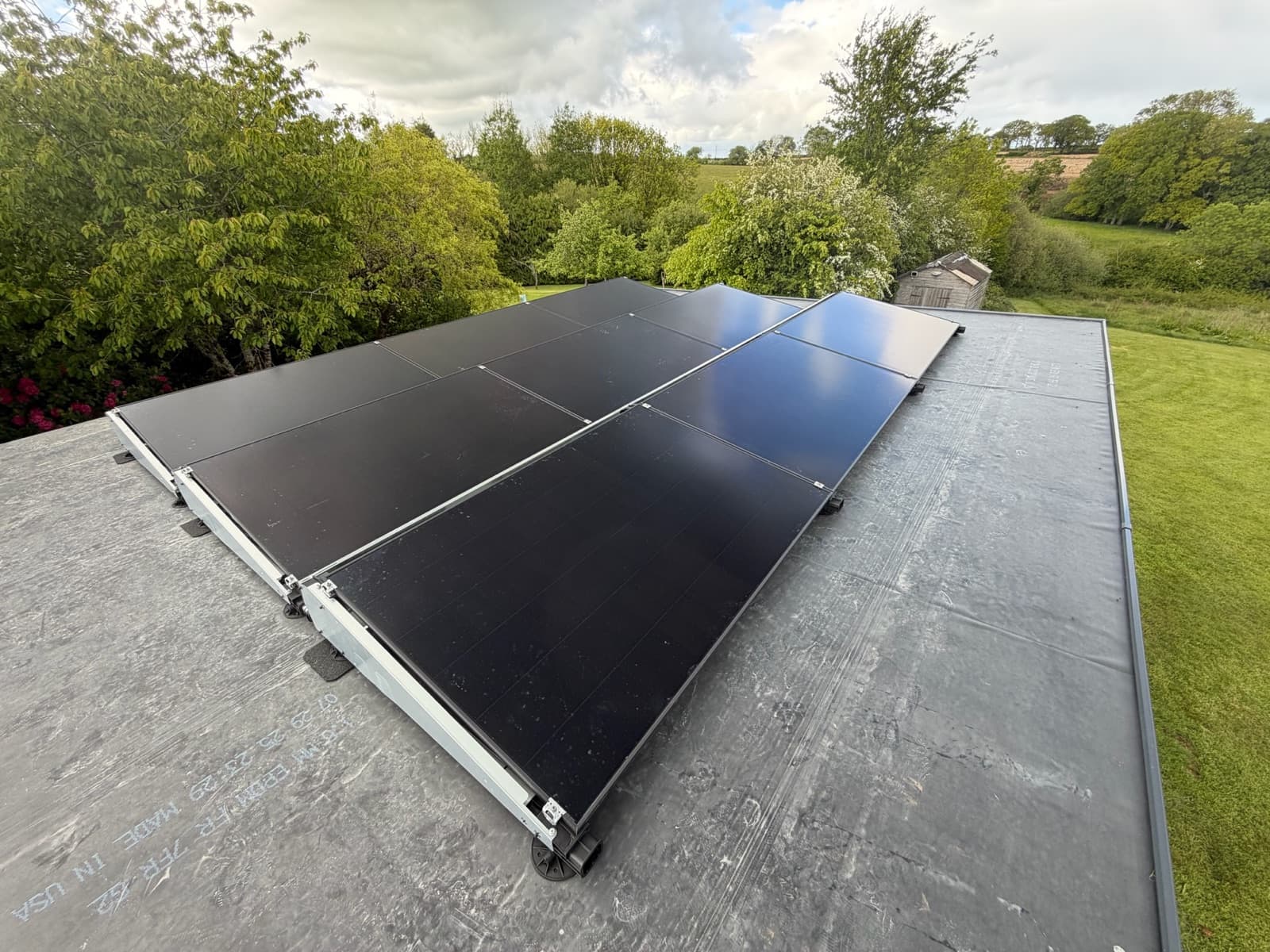
AIKO Neostar 3P+54, all-black monocrystalline, 485W each at 1,762 × 1,134mm. Ten of them is 4.85kW, which is a common size on a semi; sixteen is 7.76kW. Fifteen-year product warranty, thirty-year performance warranty.
Inverter
A 6kW hybrid as standard, so storage can be added later without replacing it — worth doing even if you're not fitting a battery now. EcoFlow PowerOcean on most domestic jobs, with a fifteen-year warranty; SolaX where the job calls for it, and on commercial installations.
Roof aspects
More than one aspect is an advantage, not a problem. East and west together spread generation across the morning and the evening instead of stacking it all at noon.
Mounting and scaffold
In-roof or on-roof rails, scaffold where the pitch needs it. Included in the quote, not added afterwards.
Monitoring
An app showing generation, use and export, set up and working before we leave site.
Paperwork
MCS certification, building control notification and the DNO approval, all handled by us. Bird protection to the array edges is included as standard, not sold as an extra.
Warranty
Five years on our workmanship, on top of the manufacturers' warranties on the panels, inverter and battery. A 10% deposit books the date; the balance is due once the installation is finished.
How it goes
Free survey
The roof, the consumer unit, the cable route, and how you actually use electricity through the day.
Fixed quote
In writing, specified for your property. Not a penny more on the day. A 10% deposit books the date.
Installation
Cables concealed, site left clean. Most homes are a day or two on site.
Handover
Certification, the DNO paperwork and your monitoring app, all set up before we leave.
Solar, the common questions
Most are. South is best but east and west both work — an east/west split gives up about 18% of a due-south system's annual output, which is usually still worth fitting. What actually rules a roof out is heavy shading from a chimney or a tree at the wrong time of day. We measure that at survey using the MCS shading method, and it goes into your quote as a stated shade factor rather than being glossed over.
It's set by usable roof area rather than by what you'd like. A typical semi takes ten to sixteen of the 485W panels — 4.85kW to 7.76kW. We size the array against your annual consumption, because a system that generates far more than you can use exports the surplus at 16p and buys it back at 28p.
Yes. They generate from daylight, not heat, so a grey Midlands afternoon still produces — just less. It's the reason we size on annual generation rather than peak output.
Very little. Rain handles most of the cleaning on a pitched roof. The panels we fit are warranted on performance for thirty years and degrade slowly — about 1% in the first year and 0.35% a year after that. The inverter is the part most likely to need attention first.
Most homes are a day or two on site once the scaffold is up.
Find out what your roof would do.
A free survey, a fixed written quote, and no obligation to go ahead. Slots this week across Solihull and Birmingham.
- We call you back the same day
- Free survey — no obligation, no pushy sales
- Itemised quote in writing, fixed before we start